Universities Just Handed AI Agents the Keys to the Lab. Nobody's Worked Out What It Costs.
Are U.S. universities quietly turning software engineering students into scientific operators as agentic AI moves from coding assistants into autonomous research workflows?
Short Answer
Yes — quietly, and in a very specific, traceable way. In the last three months of 2026, at least four federally- or institutionally-backed university labs (UT Knoxville, the University of Missouri, Missouri S&T, and UC Santa Cruz) started running AI agents as active participants in the research loop itself, not as coding assistants sitting off to the side. Stanford is simultaneously teaching the exact skills this requires — tool registries, provenance tracking, evaluation design — as for-credit coursework. That's a real pattern, not a vibe. But there's a catch worth taking seriously before anyone gets excited: Stanford's own Digital Economy Lab just measured how unpredictable and expensive agentic work actually is, and the "scientific operator" role this implies doesn't have a job title, a salary band, or a degree track yet. The infrastructure is ahead of the labor market.
Why 2026, Specifically
None of this happened in a vacuum. The Department of Energy announced its "Genesis Mission" — a nationwide push to use AI to accelerate scientific discovery — in late 2025, and spent the first half of 2026 standing up its first consortium awards. A University of Missouri-led team was one of the winners, selected for a project literally titled "Toward a U.S. Institute for Cell Design: AI-Driven Computer-Ready Synthetic Cells with Quantum Integration."
Around the same time, NSF was writing two separate checks to UT Knoxville — $9 million for a national AI-driven scientific-data infrastructure project, and $20 million for an autonomous-materials-discovery hub called ATHENA — while Stanford's own AI co-scientist, Biomni, went from research demo to a tool actively running in more than 10,000 labs. That's not one story with one cause. It's four independent funders (DOE, NSF twice, and a university's own philanthropic seed fund at UC Santa Cruz) converging on the same bet inside about six months: pay for AI agents to do lab work, not just write code.
How This Connects
open_with Drag nodes to rearrange, tap one for the evidence behind it — pinch or scroll to zoom.
The Grant Money Says One Thing. The Cost Data Says Another.
Here's the tension the funding announcements don't mention: the same institution funding one side of this story just published research undercutting the other side. Stanford's Digital Economy Lab — a completely separate group from the team that built Biomni — published "How Do AI Agents Spend Your Money? Analyzing and Predicting Token Consumption in Agentic Coding Tasks" in May 2026, studying eight frontier models on SWE-bench Verified (the standard real-world coding benchmark). Their finding: agentic tasks burn roughly 1,000x more tokens than ordinary code chat, identical tasks vary by up to 30x in total token cost from one run to the next, and the models themselves are bad at predicting their own token usage — with correlations to actual cost as low as 0.39. Higher spend doesn't even reliably buy higher accuracy; it often peaks at a middle cost tier and flattens out from there.
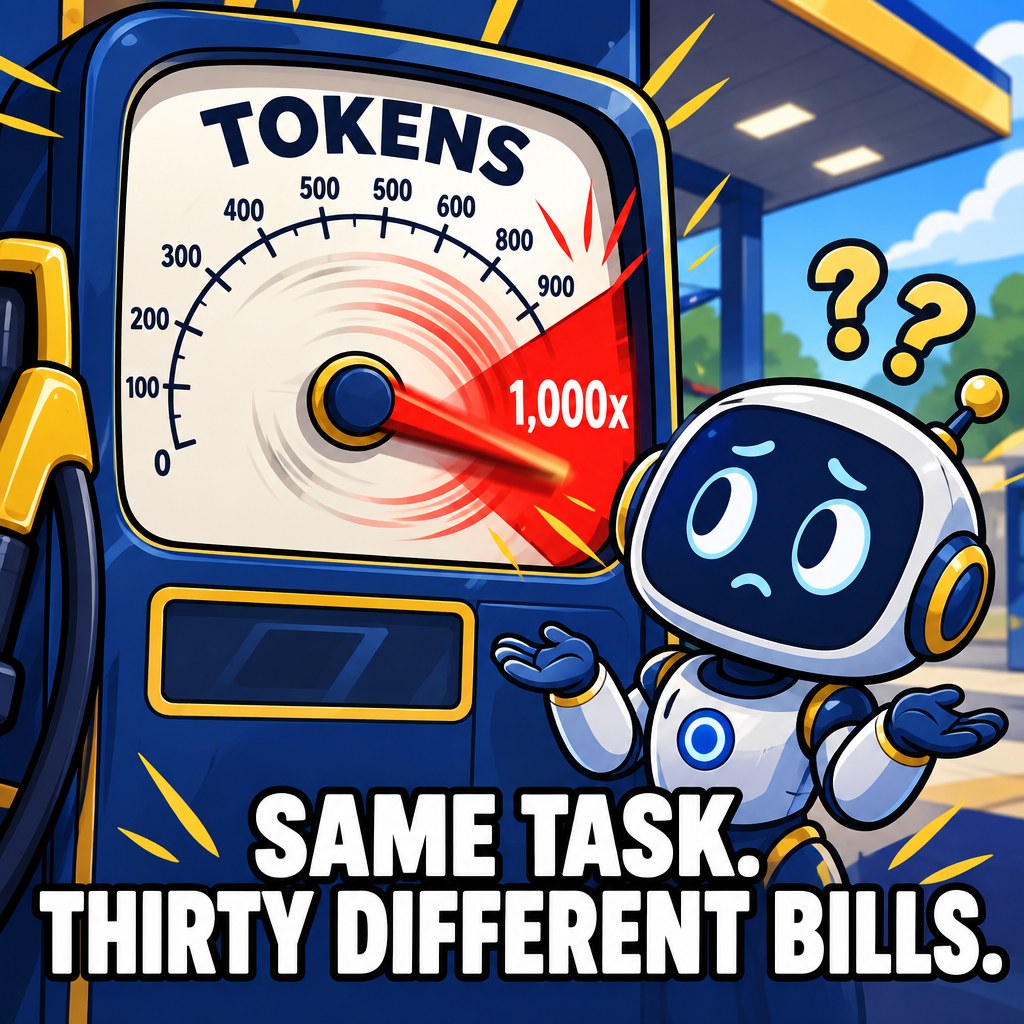
That paper wasn't about lab science specifically — it studied software engineering benchmarks. But Biomni's own architecture (a tool-calling agent working through multi-step biomedical workflows) is structurally the same shape of task DEL measured. Nobody has published a lab-specific version of that cost study yet, which means every one of the four labs above is running these systems without a clear answer to "what does a single AI-directed experiment actually cost in tokens, and how much does that vary." That's the real gap between "we funded an AI-for-science hub" and "we know how to budget for one."

The Numbers So Far
Where This Is Happening
Ground Truth: Biomni Isn't a Press Release, It's a Public Repo
Unlike most of the funding claims in this piece, Biomni is something you can go look at directly. The code is public at github.com/snap-stanford/biomni — the 150-tool, 105-package, 59-database claim isn't a marketing number, it's a countable inventory in a repo anyone can clone. That's the difference between "a university says it's building an AI-for-science tool" and "here is the tool, and here is what's actually in it." If you want to see what a professionally-scoped scientific agent looks like before you build your own, this is the fastest way in.

Methodology
This piece draws on primary sources only: NSF and DOE award/selection pages and the universities' own research-office announcements (UT Knoxville, University of Missouri, Missouri S&T, UC Santa Cruz), Stanford's own course pages for CS224V and CS329Z, the Stanford Report's coverage of Biomni (cross-checked against the GitHub repo and the paper's PubMed listing), and the Digital Economy Lab's own publication page for the token-consumption study. What's missing: no direct interviews with PIs at any of the four labs about how they're actually staffing or budgeting these projects; no confirmed dollar figure for Mizzou's DOE Genesis Mission award; no enrollment or post-graduation placement data for CS224V/CS329Z; and no lab-specific replication of the Digital Economy Lab's cost study (their benchmark was software engineering, not biomedical or materials-science agent tasks specifically).

Moral of the Story
If you're a student: you don't need to wait for a university to invent a "Scientific Operator" major. Clone Biomni, read how its tool registry and evaluation layer are actually built, and build a five-tool toy agent with real evals over a weekend — that's the literal skill CS329Z is grading on, and it's free to practice regardless of where you go to school.

If you're a PI outside these four institutions: the funding case for an AI-agent lab program just got easier to write (you can cite $29M+ in NSF awards to one university alone), but the budget case just got harder — the Digital Economy Lab handed you the honest risk language for free ("token cost varies up to 30x run-to-run, and the models can't predict their own spend"). Use it. Don't let a grant proposal promise a fixed cost per experiment nobody can currently guarantee.
If you're hiring: stop assuming a standard CS degree teaches agent orchestration and evaluation. Right now, that's explicitly taught at a handful of named programs (Stanford's CS224V/CS329Z are the clearest public example) — if you need it, either recruit from there specifically or budget to train it in-house.
If you're a founder: Open Culture Science is the proof pattern — take the expensive, repetitive step inside a real funded lab, automate it, spin it out. Watch which of these four centers produces the next one; UCSC already did it once from the same seed fund cited above.
Related Research
Where This Stands
Answered
Our Best Guess So Far
Our best guess: the technical pattern (tool registries, provenance, evaluation) is genuinely converging across biomedicine, materials science, synthetic biology, and genomics labs — but the labor-market side (a real job title, a real salary band, a real degree track called anything like 'scientific operator') hasn't caught up yet, and the cost side (what an AI-directed experiment actually costs in tokens) is an open, unsolved question even inside the lab that's best positioned to answer it.
What Got Us Asking This
- linkUT Knoxville: $9M + $20M NSF awards, July 2026 — One grant for national AI-driven scientific-data infrastructure, one for the ATHENA autonomous-materials-discovery hub.
- linkMizzou-led team selected for DOE's inaugural Genesis Mission — A 6-institution AI-driven synthetic-cell-design project, led by a Mizzou mechanical/aerospace engineering professor.
- linkStanford Biomni: 150 tools, 105 packages, 59 databases, 10,000+ labs — Published in Science, July 2026 — the most widely used AI co-scientist system in biomedicine per Stanford's own reporting.
- linkStanford Digital Economy Lab: agentic tasks burn ~1000x more tokens than chat — May 2026 study of 8 frontier models on SWE-bench Verified — the tension this whole piece turns on.
How This Connects
The Physical Side
Federally-funded lab infrastructure at UT Knoxville (the ATHENA autonomous-materials hub) and DOE's multi-institution Genesis Mission compute/experimental stack led out of Missouri.
The Money Side
$29M in 2026 NSF awards to UT Knoxville alone, a DOE Genesis Mission slot for a Mizzou-led team, and a $450K UCSC seed fund — three different funding tiers, all pointed the same direction.
The Day-to-Day Work
PIs and grad researchers running closed-loop, AI-directed experiment cycles instead of hand-running every step — Biomni alone is already active in more than 10,000 labs.
The Data/Systems Side
The technical pattern repeats everywhere it shows up: a registry of specialized tools, provenance tracking, and evaluation — exactly what Stanford's CS224V and CS329Z now teach as for-credit coursework.
Who We'd Like to Talk To
- University PIs running federally funded AI-for-science labs
- CS/AI grad students choosing a research specialization
- Hiring managers building AI-for-science or agent-evaluation teams
- University tech-transfer offices watching for the next spinout
What We Still Need
- Confirmed dollar figure for Mizzou's DOE Genesis Mission award
- CS224V/CS329Z enrollment and post-graduation placement data
- A lab-specific (not software-engineering-benchmark) replication of the Digital Economy Lab's token-cost study
- Direct interviews with PIs at UTK, Mizzou, and UCSC on how they're actually staffing these roles
What We'll Build From This
- A tracked roster of every federally-funded 'AI-for-science' lab opening in 2026-27, cross-referenced against which universities teach agent-engineering coursework
- A cost-per-experiment model combining the Digital Economy Lab's token-cost findings with a real lab's grant budget
What We Found
Four independent funders (NSF twice, DOE, and a university's own seed fund) backed AI-agent-driven lab infrastructure within roughly six months of each other in 2026, and the underlying technical pattern — tool registries, provenance, evaluation — is the same at every site and is now taught as Stanford coursework. But no university has created a formal 'scientific operator' job title or degree track, and Stanford's own Digital Economy Lab research shows the token-cost economics of this kind of agentic work are still highly unpredictable, undercutting how confidently any of these labs can currently budget for it.
Sources
- linkUT Knoxville — $9M NSF AI-Driven Scientific Data Infrastructure Project
- linkUT Knoxville — $20M NSF ATHENA Autonomous Materials Discovery Hub
- linkMizzou-led team selected for DOE's inaugural Genesis Mission
- linkMizzou launches AERI (AI Education, Research and Infrastructure Center)
- linkMissouri S&T — Kummer Research Ignition Grant Initiative (Center for AI and Autonomous Systems)
- linkUC Santa Cruz Genomics Institute — 2026 seed funding
- linkOpen Culture Science (UCSC Genomics Institute spinout)
- linkStanford Report — Meet Biomni, an AI-powered biomedical co-scientist
- linkBiomni GitHub repository
- linkStanford CS224V — Agentic AI, Fall 2026
- linkStanford CS329Z — Engineering AI Agents, Fall 2026
- linkStanford Digital Economy Lab — How Do AI Agents Spend Your Money?