Florida Turned Its Supercomputer Into Plumbing. 30,800 People Now Just Use It.
What changes when a university stops treating AI as a course or lab and starts operating it like shared infrastructure — compute, models, data, training, governance, and access for thousands of users?

Short Answer
What changes is who has to ask permission. When AI lives in one department's lab, a biology professor with a real research question has to go find a CS collaborator, write a joint grant, and wait a semester. At the University of Florida, that professor logs into NaviGator AI, picks from 70 large language models, and starts working the same afternoon — because HiPerGator, UF's supercomputer, and NaviGator, its AI gateway, are now treated as campus plumbing, not a departmental asset. The number that makes this concrete: 30,800-plus unique users across NaviGator AI, more than 200 AI-designated courses open to any student regardless of major, and $566 million in externally funded research the university says HiPerGator directly enabled in the last academic year alone. UF's own published case study on how this happened makes an argument worth taking seriously: the $85 million in hardware and matching funds was the easy part. What actually made it work was six years of executive alignment and staff support that doesn't show up in a purchase order.
Why This Became UF's Strategy, Not Just Its Supercomputer
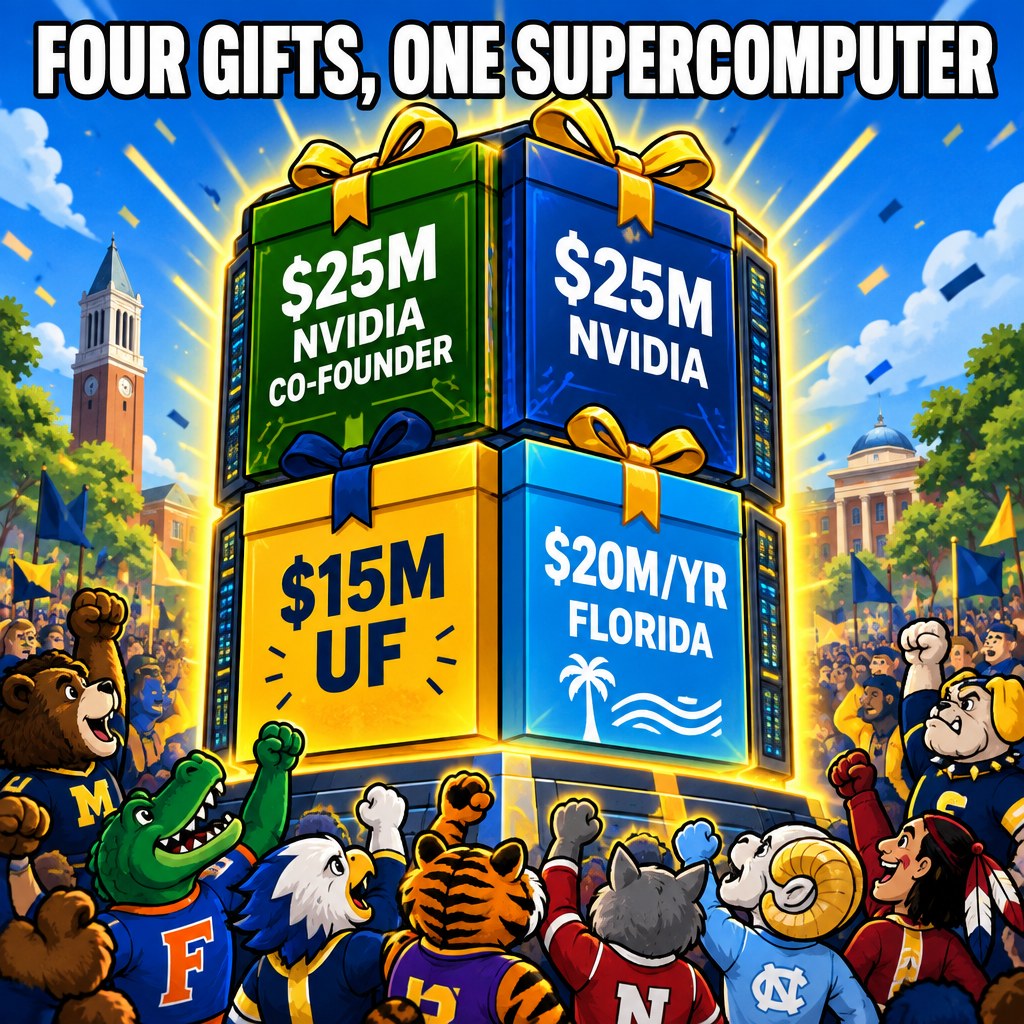
The story starts with a single gift. In 2020, NVIDIA co-founder Chris Malachowsky, a UF alumnus, gave $25 million toward a new AI-capable supercomputer, matched by another $25 million in hardware and support from NVIDIA itself, $15 million from the university, and $20 million in recurring funding from the state of Florida — $85 million total. That bought the machine. It didn't, on its own, buy the outcome. UF's own account of what happened next, published in May 2026 as the inaugural title in the university press's new Warrington Case Series, makes the point explicitly: the hardware was "the catalyst," but the actual transformation depended on "precursors that don't come in a crate" — meaning executive buy-in across all 16 colleges and staff whose job was making the system usable by people who aren't computer scientists. UF hired 106 AI-focused faculty between 2020 and 2022, specifically distributed across every college, not concentrated in engineering or CS. That staffing decision, more than the hardware spend, is the part of this story that's actually replicable by a university that doesn't have a supercomputer-scale gift sitting in front of it.
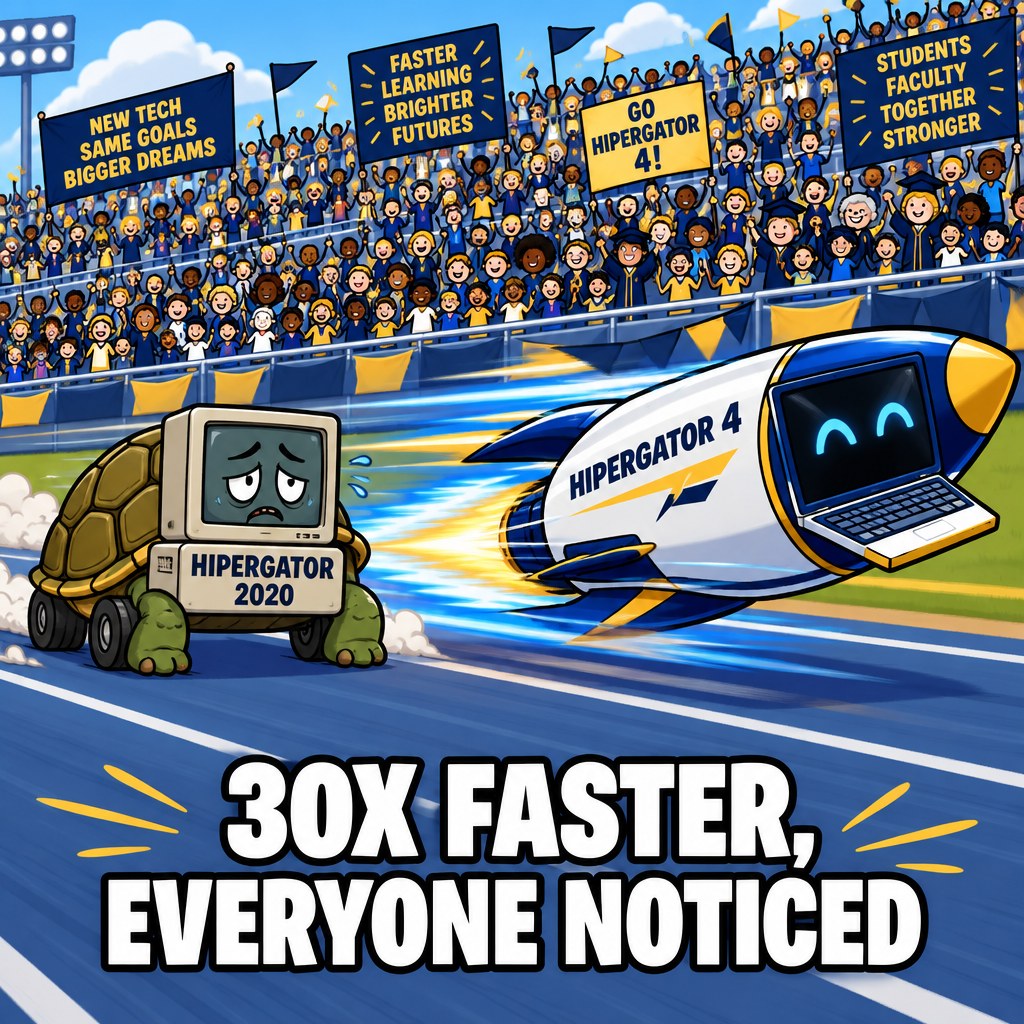
By September 2025, HiPerGator was on its fourth generation, now built around an NVIDIA DGX B200 "Blackwell" SuperPOD roughly 30 times faster than the 2020-era system it replaced, with 1,500-plus students and 3,700-plus faculty and staff actively using it. NaviGator AI, the access layer sitting on top of the raw compute, is the part that actually makes "utility" the right word instead of "supercomputer": it's a gateway, not a research tool you need a grant to touch, and its 30,800-plus users are drawn from every corner of campus, not just AI researchers.
How This Connects
open_with Drag nodes to rearrange, tap one for the evidence behind it — pinch or scroll to zoom.
The Real Finding: The Hardware Wasn't the Hard Part
Most coverage of a university supercomputer story leads with teraflops. UF's own case study — written by a UF marketing professor and published through the university's own press, so treat it as a self-assessment rather than independent evaluation — makes a more interesting and more useful claim: the $85 million bought the machine, but what made HiPerGator function as a campus-wide utility rather than an engineering department's toy was six years of unglamorous organizational work. Executive sponsorship that survived multiple budget cycles. A faculty-hiring plan that deliberately put AI expertise in all 16 colleges instead of concentrating it in Computer & Information Science & Engineering. Staff whose job was making a supercomputer usable by an agronomy professor who's never written a line of CUDA code. That's a genuinely different story from "we bought a fast computer," and it's the part most other universities trying to replicate this can actually copy — you don't need a $25 million alumni gift to decide where your next 100 faculty hires go.

The honest tension sits inside UF's own headline number: 71% of Spring 2026 graduates completed at least one AI course. That's a real, sourced, impressive breadth statistic. It's also a genuinely low bar — "at least one course" measures exposure, not competence, and UF's own reporting doesn't break out how many of those 14,000 annual enrollments are a single elective versus a full AI-focused course sequence. Read generously, it's evidence AI literacy is now baked into the university experience broadly. Read skeptically, it's a number that could describe a single required orientation module just as easily as real technical depth. Both readings are consistent with the data UF has published; the site doesn't have the course-level breakdown needed to tell them apart.

The Numbers So Far
Where This Is Happening
Ground Truth: A Water Scientist, Not a Computer Scientist, Just Used It to Win an NSF Grant
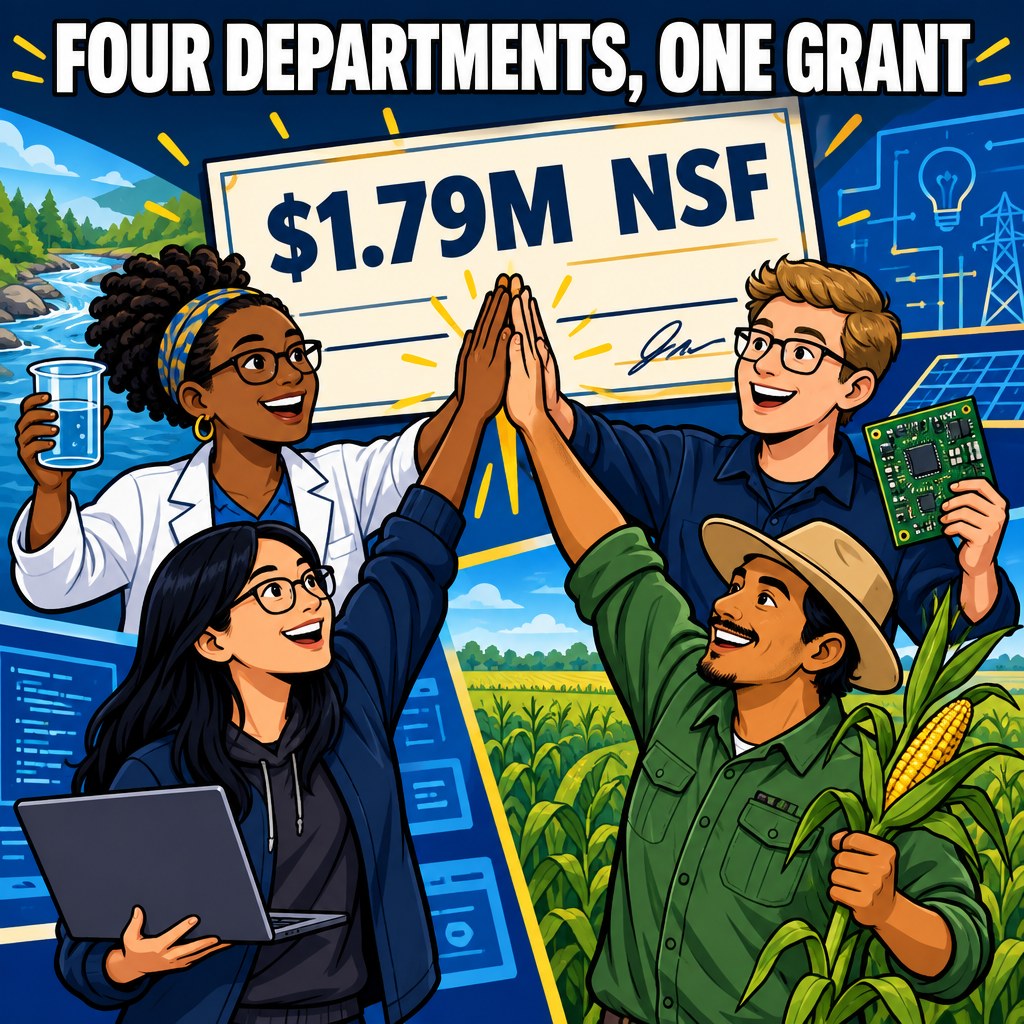
The clearest evidence that "AI as utility" isn't just a marketing phrase is a grant that has nothing to do with computer science on its face. In August 2026, an NSF award of $1.79 million went to a UF Water Institute-led team — Director Matt Cohen, electrical/computer engineering's Joel Harley, computer science's Emmanuel Dorley, and agronomy's Chang Zhao — to build AI tools predicting coupled water and carbon dynamics, explicitly built on HiPerGator's compute. That's a hydrologist and an agronomist as co-PIs on an AI grant, using infrastructure they didn't have to build, request special access to, or justify with a joint appointment. That's what "utility" is supposed to mean in practice: the compute was already there when the actual science question showed up.
Methodology
This piece draws on the University of Florida's own July 2026 AI Year in Review, the May 2026 Warrington Case Series case study "Building an AI University" (a UF Press publication, written by a UF marketing professor — a self-assessment, not third-party evaluation), UF's HiPerGator 4 unveiling coverage, the NSF's own Water Institute grant announcement, and NSF/FedScoop reporting on the NAIRR Operations Center for the national-scale comparison. What's missing: an independent (non-UF-authored) assessment of the case study's causal claims; a course-level breakdown of what "completed at least one AI course" actually covers; and a comparable cost/outcome breakdown for any other university attempting the same campus-wide model, which would be needed to say how replicable this actually is outside a university that received an unusually large alumni gift.

Moral of the Story
If you're a student outside CS: you don't need to be an engineering major to use this infrastructure — UF's own numbers show non-CS faculty are already winning federal grants built on it. Ask your own department's advising office whether your university has an equivalent AI-access gateway, and if it doesn't, that's a real, specific ask to bring to a department chair.

If you're a professor building a grant proposal: the Water Institute's $1.79M NSF award is a template, not a fluke — a hydrologist, an ECE professor, a CS professor, and an agronomist co-authored it. If your university has any shared AI compute access, a genuinely interdisciplinary team is a stronger pitch than a single-department one.

If you're a university administrator: UF's own case study argues the hardware wasn't the hard part — replicate the faculty-distribution decision (AI expertise placed in every college, not just engineering) before assuming you need a nine-figure gift to start. That's the part of this story that doesn't require an NVIDIA co-founder on your alumni list.

If you're a vendor or founder building tools for universities: the real infrastructure play here isn't the supercomputer — it's the access layer. NaviGator AI is the reason 30,800 people use HiPerGator instead of 3,700; a well-built gateway is worth more adoption than raw compute alone.
Related Research
Where This Stands
Answered
Our Best Guess So Far
Our best guess: institutions that treat AI as shared infrastructure (broad faculty distribution across colleges, a direct-access gateway layer, executive sponsorship that survives multiple budget cycles) diffuse real capability faster than departments redesigning curricula on their own — but UF's own case study is a self-assessment, not independent evaluation, and we don't yet have a comparable cost/outcome breakdown from a university attempting this without a nine-figure alumni gift.
What Got Us Asking This
- linkUF AI Year in Review: 30,800+ NaviGator users, 200+ AI courses, $566M in HiPerGator-enabled research — UF's own July 2026 report — NaviGator AI gateway offers 70 LLMs; HiPerGator directly enabled $566M in externally funded research in the last academic year.
- linkWarrington Case Series: "Building an AI University" (May 2026) — UF's own case study: the $85M funding stack was 'the catalyst,' but faculty hiring and executive alignment across all 16 colleges is what the case study credits as the actual driver.
- linkNSF awards UF Water Institute $1.79M for HiPerGator-built environmental AI forecasting — A hydrologist, an ECE professor, a CS professor, and an agronomist as co-PIs — a non-CS team winning a federal grant on shared AI infrastructure they didn't have to build.
How This Connects
The Physical Side
HiPerGator 4's Blackwell SuperPOD compute layer at UF, plus UT Austin's TACC as a national-scale comparison point inside the $35M NSF NAIRR Operations Center.
The Money Side
$85M funding stack behind HiPerGator (a $25M NVIDIA co-founder gift, $25M from NVIDIA, $15M from UF, $20M recurring from the state of Florida), against $566M in externally funded research the university attributes to HiPerGator access in one year.
The Day-to-Day Work
106 AI-focused faculty hired across all 16 UF colleges (2020-22), not concentrated in engineering/CS — the staffing decision UF's own case study credits over the hardware itself.
The Data/Systems Side
NaviGator AI, UF's direct-access gateway offering 70 LLMs to any student, faculty, or staff member — the layer that turns raw compute into something usable without a grant or a CS collaborator.
Who We'd Like to Talk To
- Non-CS faculty considering an AI-enabled grant proposal
- University administrators weighing a campus-wide AI infrastructure investment
- Students outside computer science deciding whether AI coursework applies to their major
- Vendors/founders building access-layer tools for university compute
What We Still Need
- An independent (non-UF-authored) assessment of the Warrington Case Series' causal claims
- A course-level breakdown of what 'completed at least one AI course' actually covers for the 71%-of-graduates figure
- A comparable cost/outcome breakdown from a university attempting a similar model without a comparable alumni gift
- Confirmation of how much of the $566M HiPerGator-enabled research figure is AI research specifically vs. any HiPerGator-supported research broadly
What We'll Build From This
- A University AI Infrastructure Scorecard comparing compute access, model gateway breadth, course diffusion, and governance model across institutions
- A tracked roster of non-CS-led federal grants built on shared university AI compute
What We Found
The University of Florida's HiPerGator supercomputer and NaviGator AI gateway (30,800+ users, 200+ AI-designated courses, $566M in externally funded research UF attributes to HiPerGator access in the last academic year alone) is the clearest working example in this radar pass of a university operating AI as shared infrastructure rather than a departmental resource. UF's own case study argues the $85M funding stack that bought the hardware in 2020 was 'the catalyst,' not the cause — what the university credits with making it work is six years of faculty hiring distributed across all 16 colleges and sustained executive sponsorship, evidenced concretely by a Water Institute-led team of a hydrologist, an ECE professor, a CS professor, and an agronomist winning a $1.79M NSF grant built directly on HiPerGator compute. That staffing-and-governance lesson, unlike the nine-figure gift that started it, is the part plausibly replicable at a university without UF's specific funding history.
Sources
- linkUniversity of Florida — AI Year in Review, July 2026
- linkUniversity of Florida — Warrington Case Series: "Building an AI University," May 2026
- linkUniversity of Florida — HiPerGator 4 unveiling, fastest supercomputer in higher education
- linkUF Water Institute — $1.79M NSF grant for AI-powered environmental forecasting
- linkFedScoop — NSF announces up to $35 million to stand up AI research resource operations center