movie Season 1 · 6 episodes · 39 minutes · free

The Curve

Most of the class is failing EECS 203, and Professor Hale says she'll curve the exams. Five strangers thrown together as a study group — Jaylen, who's never failed anything; Bryce, who's secretly failing everything; Anika, who freezes on exams; Marisol, who works overnights; and Yusuf, who shares everything — have to learn logic, proofs, infinity, induction, counting and graphs together. To pass, they have to stop competing, stop lying about where they stand, and prove it.

video_library The Season

Watch in order. Then do the homework.

Every episode teaches one unit of discrete math with a picture first, then the proof — and ends with a problem set that drills it. Pause when they say pause; try it before they do.

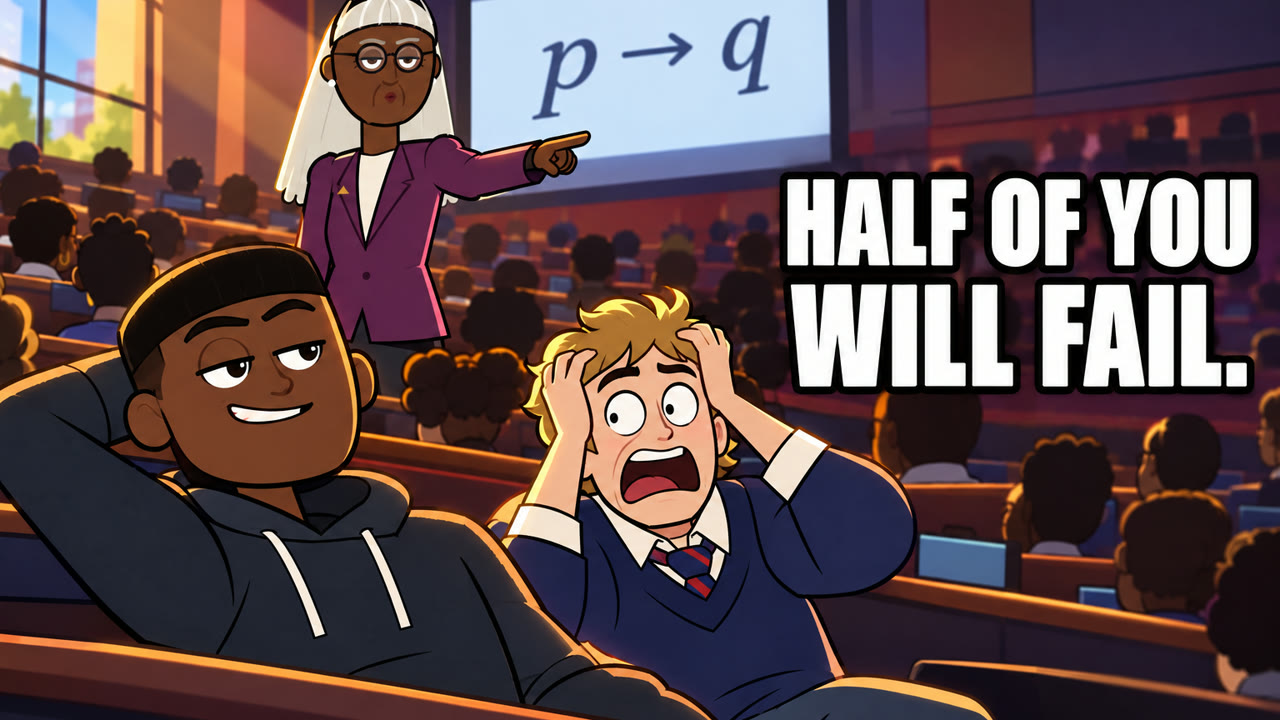
Half of You Will Fail: Logic, Truth Tables & Knights and Knaves | The Curve Ep 1 (Discrete Math)8:41
Episode 1

Knights and Knaves

An if-then is a promise. It's only broken when you do your part and they don't do theirs.

  • Propositions, truth tables, and the one row that breaks p → q (vacuous truth)
  • Converse vs. contrapositive — and the Wason card test (A and 7, not A and 4)
  • Negating "for every": the opposite of everybody's failing is somebody isn't
  • Proof by cases: knights and knaves without knowing everything
edit_note Activity · Knights and knaves, by cases
  1. A says "B is a knave." B says "A and C are the same type." Write down both possibilities for A.
  2. Case 1, A is a knight: A tells the truth → B is a knave → B's sentence is false → A and C differ → C is a knave.
  3. Case 2, A is a knave: A lied → B is a knight → B's sentence is true → A and C are the same → C is a knave.
  4. Every case says C is a knave, so C is a knave. ∎ (You never needed to know A.)

Journal this

THE PROOF FRAMEWORK
GIVEN:      what do we know? (write the definitions out)
PROVE:      exactly what must be shown — for every case
STRATEGY:   direct · contrapositive · contradiction · cases · induction
DERIVATION: every line + its reason
∎           did we prove the original claim, every case?

Talk about it

  • Treating p → q as broken when p is false (it's vacuously true)
  • Mixing up the converse q → p with the contrapositive ¬q → ¬p
  • Negating "everybody fails" as "everybody passes" (it's "somebody doesn't fail")
  • Stopping after one case of a proof by cases
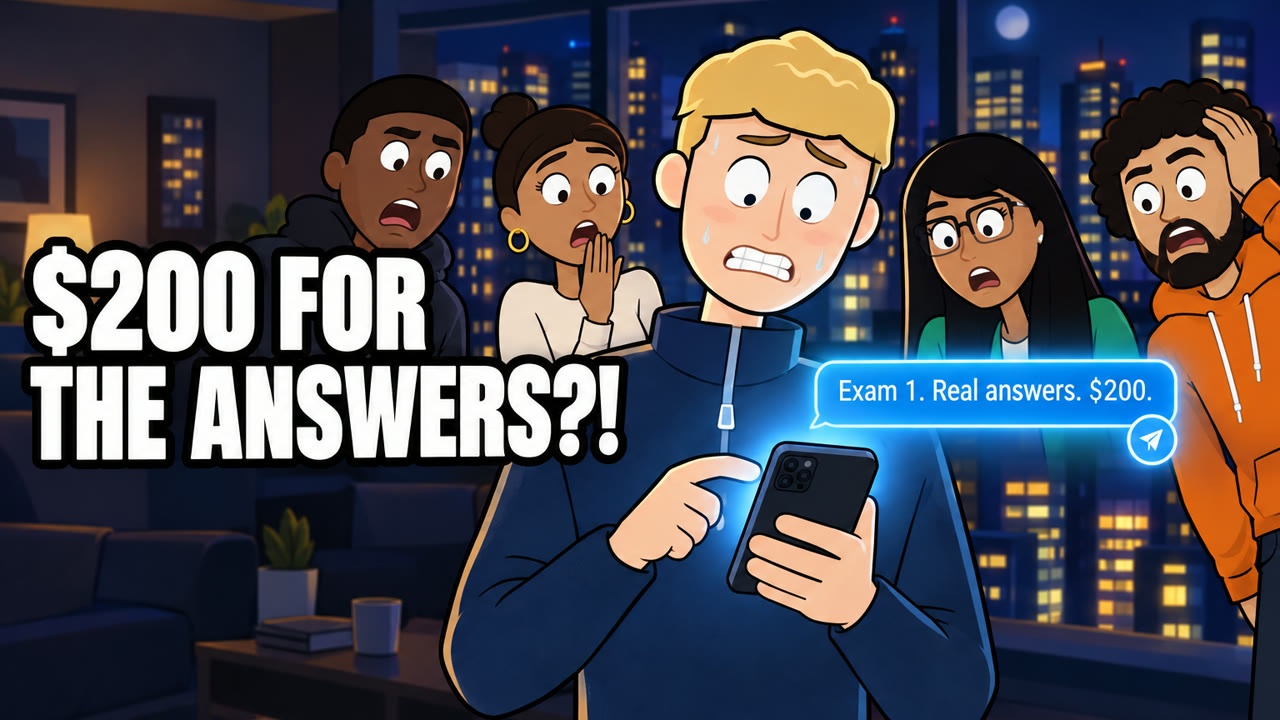
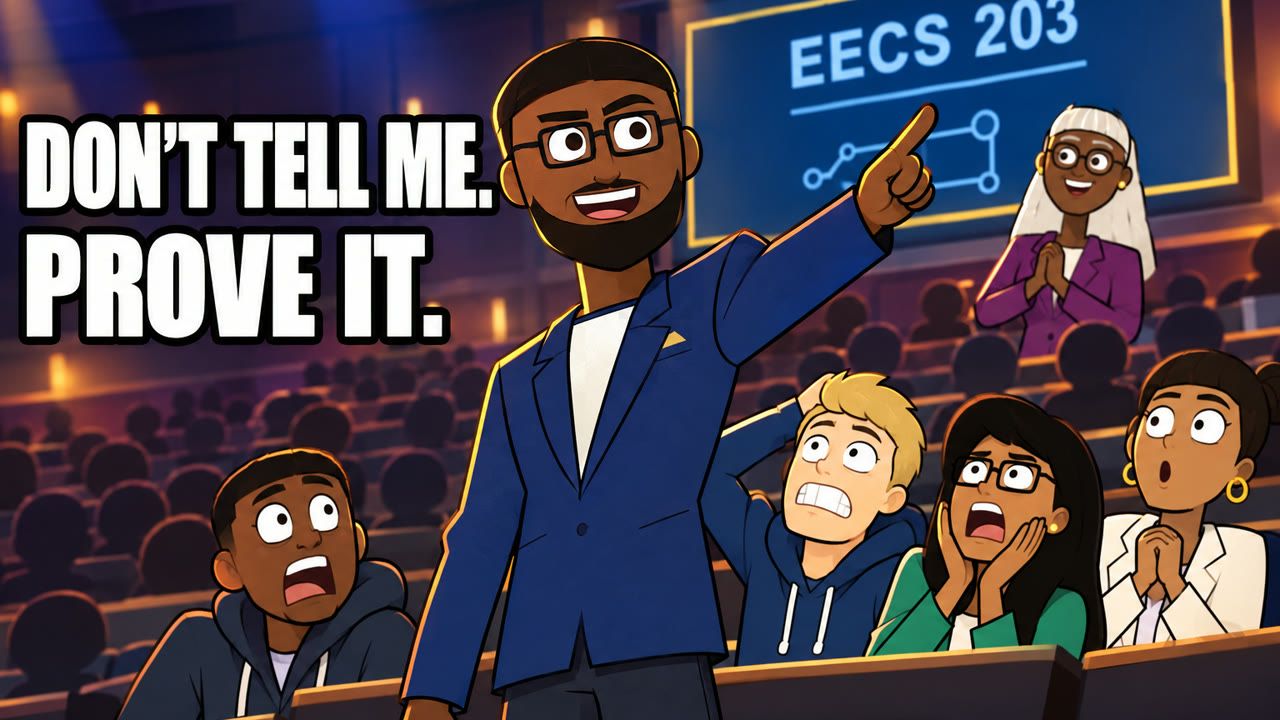
$200 for the Exam Answers? How to Write a Proof (Contrapositive, Contradiction) | The Curve Ep 27:15
Episode 2

Proof by Contradiction

A proof is an argument nobody can wiggle out of. Checking examples is a feeling, not a proof.

  • Why examples aren't proofs (n² + n + 41)
  • Direct proof: odd + odd = even, as pairs and as algebra
  • Contrapositive: n² even → n even
  • Contradiction: √2 is irrational; squares leave remainder 0 or 1 mod 4
edit_note Activity · √2 is not a fraction
  1. Pretend √2 = a/b, already in lowest terms.
  2. Square both sides: a² = 2b², so a² is even, so a is even (the contrapositive proof). Write a = 2c.
  3. 4c² = 2b², so b² = 2c², so b is even too.
  4. Both even contradicts lowest terms. The pretend was wrong: √2 is irrational. ∎

Journal this

PROOF BY CONTRADICTION
CLAIM:    ______________________
PRETEND:  the opposite is true: ____
FOLLOW:   step → step → step (reasons)
BREAKS:   ⚡ ____ contradicts ____
SO:       the pretend was wrong. ∎

Talk about it

  • "I tried a bunch of numbers" — a feeling, not a proof
  • Using the converse instead of the contrapositive
  • Contradiction proofs that never actually reach a contradiction
  • Dividing by something that might be zero
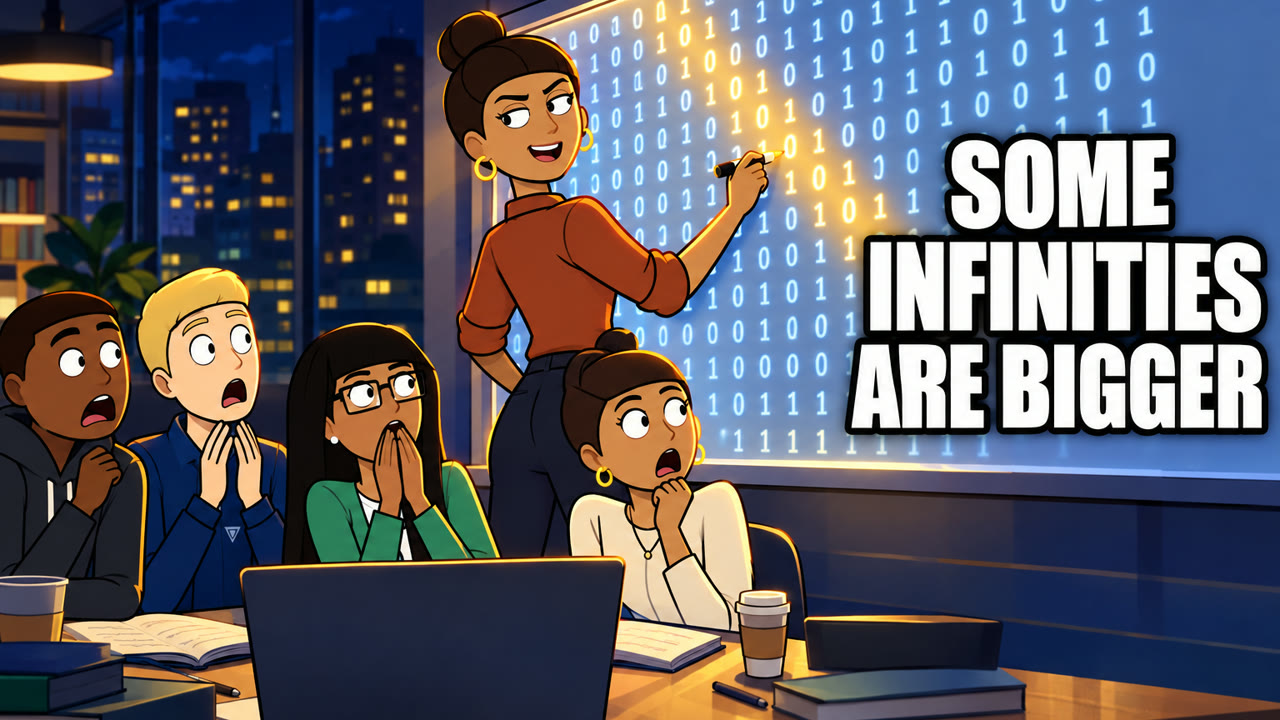
Some Infinities Are Bigger Than Others: Sets, Functions & Cantor's Diagonal | The Curve Ep 35:59
Episode 3

Some Infinities Are Bigger

Two sets are the same size when you can pair them up perfectly, with nobody left out.

  • Sets, ∩ (and) and ∪ (or)
  • Functions, one-to-one, onto, and bijections
  • Hilbert's Hotel and |ℕ| = |ℤ| (the zigzag)
  • Cantor's diagonal: infinite binary strings can't be listed
edit_note Activity · Cantor's diagonal
  1. Pretend every infinite 0/1 string is in a list s₁, s₂, s₃, …
  2. Build s: flip digit 1 of s₁, digit 2 of s₂, digit 3 of s₃, …
  3. s differs from every sₙ in spot n, so it isn't on the list.
  4. Contradiction: the strings can't be listed. They're uncountable. ∎

Journal this

SAME SIZE?
1. find a rule f from A to B
2. one-to-one: f(x) = f(y) → x = y
3. onto: every b in B is f(something)
4. both → bijection → |A| = |B|

Talk about it

  • "A proper subset is smaller" — only for finite sets
  • Forgetting to show onto (or one-to-one) — you need both
  • Thinking the diagonal string might be on the list somewhere later
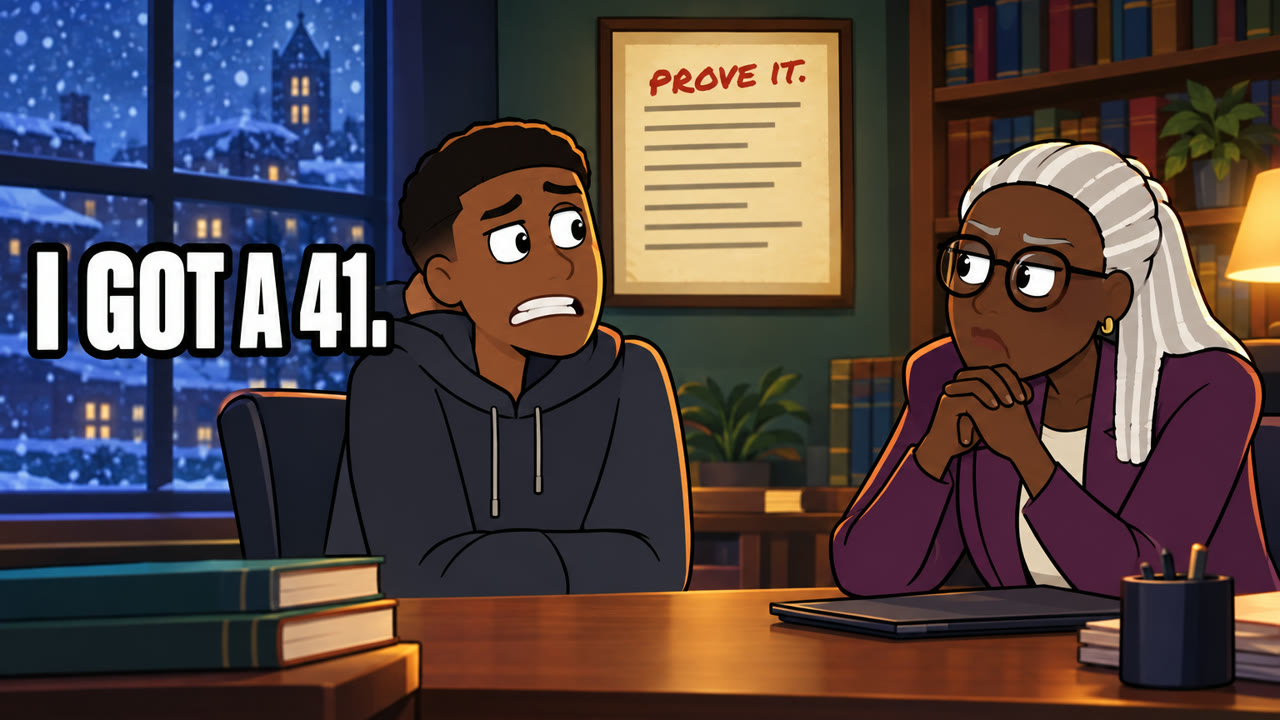
I Got a 41 — How Induction Actually Works (Staircases, Gauss & Trominoes) | The Curve Ep 46:03
Episode 4

The Next Step

Induction: get on the first step, and prove that from any step you can reach the next one.

  • Base case + inductive step = every step
  • 1 + 2 + ⋯ + n = n(n + 1)/2, as a picture and by induction
  • Strong induction: postage from 4¢ and 5¢ (four base cases)
  • The tromino tiling proof
edit_note Activity · Prove 1 + 2 + ⋯ + n = n(n + 1)/2
  1. Base, n = 1: 1 = 1·2/2. ✓
  2. Assume 1 + ⋯ + k = k(k + 1)/2.
  3. Add k + 1: k(k + 1)/2 + (k + 1) = (k + 1)(k + 2)/2 — the formula for k + 1.
  4. True at 1, and each step gives the next, so true for all n. ∎

Journal this

INDUCTION
CLAIM:  P(n) for every n ≥ ____
BASE:   P(____) is true because ____
ASSUME: P(k) for some k ≥ ____
STEP:   use P(k) to show P(k+1): ____
∎       base + step → every n

Talk about it

  • Skipping or fumbling the base case
  • Assuming P(k + 1) instead of proving it
  • Strong induction with too few base cases
  • An inductive step that doesn't work for the smallest k (all horses are one color)
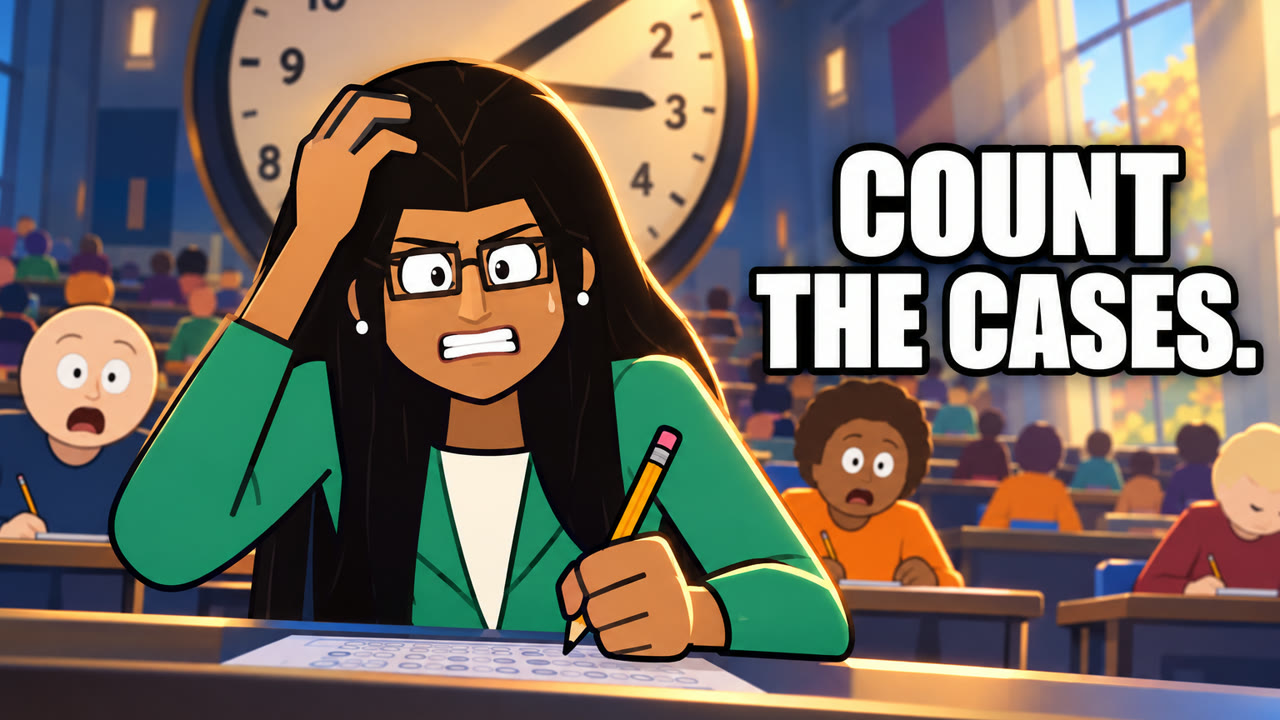
Count the Cases: Combinations, Pigeonhole, Monty Hall & Stars and Bars | The Curve Ep 55:48
Episode 5

Count Me In

Count the choices one step at a time, multiply, and divide out the orders that don't matter.

  • The product rule (outfits, passwords)
  • Order matters vs. doesn't (permutations vs. combinations)
  • The pigeonhole principle and the birthday problem
  • Monty Hall and stars and bars
edit_note Activity · 10 mana'eesh, 5 friends
  1. Line up the 10 identical breads.
  2. Drop in 4 dividers: before the 1st is friend 1's, between the 1st and 2nd is friend 2's, and so on.
  3. 14 spots, choose which 4 are dividers: C(14, 4) = 1001.
  4. If everyone gets one: hand out 5 first, then C(9, 4) = 126.

Journal this

COUNT IT
ordered, no repeats:   n·(n−1)·…   (permutation)
unordered:             divide by k!  → C(n,k)
k identical → n bins:  C(k+n−1, n−1)
more items than bins:  pigeonhole!

Talk about it

  • Counting ordered when order doesn't matter (5 × 4 = 20 co-captains)
  • Assuming two remaining doors are 50/50
  • Forgetting the leap day in the birthday pigeonhole
The Curve Was Never the Test: Graphs, the Handshake Lemma & Coloring | The Curve Ep 6 (Finale)5:33
Episode 6

The Curve

A graph is dots and lines. Count the ends of the lines and you learn what's possible.

  • Graphs, degree, and the handshake lemma
  • Euler paths: exactly two odd corners
  • Graph coloring as scheduling; why a triangle forces 3 colors
  • The curve compares you to each other; the proof compares you to the truth
edit_note Activity · Fewest time slots
  1. Draw a vertex per session and an edge for every pair that shares students.
  2. Find a triangle (Logic–Proofs–Sets): it needs 3 different colors, so at least 3 slots.
  3. Color greedily: 6 PM {Logic, Induction, Graphs}, 7 PM {Proofs, Counting}, 8 PM {Sets}.
  4. 3 works and 2 can't, so 3 is the fewest. ∎

Journal this

GRAPH CHECKS
Σ degrees = 2 × edges
Euler path: connected + 0 or 2 odd vertices
Lower bound on colors: biggest clique (triangle → 3)
Upper bound: show an actual coloring

Talk about it

  • Euler circuit claims on disconnected graphs
  • Claiming a coloring is optimal without a lower bound
  • Counting each handshake once instead of twice
menu_book

Workbook + homework

Per episode: the one sentence, words to know, the worked proofs from the episode, a homework set (warm-ups, fill-in-the-blank proofs, write-it-yourself proofs, Spot the Lie, a challenge), and a full answer key.

Download the workbook (PDF) download
account_balance

For instructors, TAs & tutors

Students in (or about to take) EECS 203 or any first course in discrete mathematics, and the instructors, TAs, tutoring centers and study groups who support them — ages 16 and up. The instructor guide covers running each episode as a discussion section, outcomes, and assessment ideas.

Download the instructor guide (PDF) download
forum

Stuck? Ask.

The Discord is open all day: setup help, concept help, and a place to talk through the system you're building.

Join the Discord open_in_new
target What students walk away with

Outcomes

  • Construct direct, contrapositive, contradiction, cases and induction proofs using one framework
  • Read and build truth tables; negate quantified statements
  • Show two sets have the same size with a bijection; explain Cantor's diagonal
  • Count with the product rule, combinations, pigeonhole and stars and bars
  • Use degrees, Euler paths and coloring to reason about graphs